Support & Sales Automation
01 / 05Agents that triage tickets, draft responses, qualify leads, and update CRM records — integrated with your existing helpdesk and sales stack rather than replacing it.
We design, build, and deploy AI workflow automation systems — from single-task AI agents to full agentic pipelines — that plug into your existing tools and take real, multi-step work off your team's plate.
AI workflow automation is the practice of using AI models and autonomous agents to execute multi-step business processes — pulling data, making decisions, calling tools, and producing outputs — with minimal or no human intervention at each step.
Traditional workflow automation follows a fixed trigger-condition-action script. AI-powered workflow automation is different: an agent interprets unstructured input, adapts to exceptions, and chooses which tool or system to call next, rather than failing outside a pre-defined path. This is what separates agentic AI workflow automation from classic RPA — the agent reasons about the task instead of replaying a script.
AI workflow automation typically spans three categories of work: data-in-data-out tasks (extraction, classification, enrichment), decision tasks (approvals, routing, prioritisation), and orchestration tasks (coordinating several systems or several agents to complete a process end to end).
Coralsoft delivers AI workflow automation across the process types businesses ask for most.
Agents that triage tickets, draft responses, qualify leads, and update CRM records — integrated with your existing helpdesk and sales stack rather than replacing it.
Multi-agent teams where a planner agent breaks down a task, specialist agents execute each step, and a supervisor agent reviews the output before it reaches a human or a system of record.
Invoice processing, reconciliations, and compliance checks — agents read documents, apply business rules, and flag anything that needs a human review.
Agents read from and write to the CRMs, ERPs, helpdesks, and internal databases you already use, without requiring a platform switch.
Pipelines that extract, classify, and enrich unstructured input — contracts, forms, emails — into the structured data your systems need.
Interest in AI workflow automation has moved from experimentation to budget line item. The pattern we see across clients: teams start with one use case — usually a support, ops, or data-entry process with clear volume and clear cost — and expand once the first agent proves reliable in production.
The businesses seeing the strongest return are not the ones automating the most workflows first; they are the ones that instrument the first one properly — with monitoring, guardrails, and a rollback path — before scaling agentic automation across the organisation. We design every engagement around that principle.
Workflow automation with AI is an architecture decision as much as an engineering one. The choices below determine how reliably your agents behave once real, messy, production data starts flowing through them.
We define how agents plan, delegate, and hand off tasks — single-agent for simple workflows, multi-agent orchestration for processes with distinct specialised steps.
Each agent is given a defined set of tools and API access — never open-ended system access — so it can act only within a scoped, auditable boundary.
High-stakes or low-confidence decisions route to a human approval step by design. We define confidence thresholds per workflow, not as an afterthought.
Every agent workflow ships with action logging, cost-per-run tracking, and automatic halt conditions for anomalous behaviour — the same operational discipline we apply to any production system.
| Layer | Components | Technology Examples |
|---|---|---|
| Reasoning | Core model powering agent decisions | OpenAI, Anthropic, Google Gemini |
| Orchestration | Agent planning, delegation, hand-offs | LangGraph, CrewAI, custom orchestration |
| Systems Layer | Tool calls, integrations | Zapier, Make, direct API hooks |
| State & Memory | Session and long-term memory storage | Postgres, Redis |
| Monitoring | Action logging, cost tracking, alerts | Datadog, Langfuse |
RPA handles high-volume, low-variance tasks reliably, but breaks down the moment an input falls outside its expected pattern. AI workflow automation handles variance far better, because the agent is interpreting intent rather than matching a fixed pattern. Where a process is stable, well-defined, and unlikely to change, a cheaper RPA tool often remains the right call. Once inputs become unstructured, exception-heavy, or unpredictable, agentic automation becomes worth the additional cost.
We follow a five-stage process built for shipping AI agents into live business processes without disrupting what already works.
We map the target workflow step by step, quantify volume and exception rate, and identify where AI agents replace effort versus where a human decision must stay in the loop.
We define agent roles, the tools each agent can call, and the guardrails and approval points for the workflow, before writing implementation code.
Agent logic, orchestration, and system integrations delivered in two-week sprints with working demos against real workflow data.
Testing against historical cases and edge cases, adversarial input testing, and load testing to confirm the agent behaves predictably at production volume.
Phased rollout alongside the existing process, a 30-day hypercare period, and ongoing tuning as the agent encounters new input patterns in production.
Order processing, returns triage, and customer support automation across peak-volume periods.
Reconciliations, compliance checks, and document-heavy back-office processes with strict audit requirements.
Lead qualification, onboarding workflows, and internal support automation that scale with user growth.
Intake processing, scheduling, and records handling with human-in-the-loop review built in.
Exception handling across shipment tracking, vendor communication, and inventory reconciliation.
Client intake, document review, and reporting workflows across multi-system environments.
Coralsoft operates as an AI workflow automation consulting agency, not a tool reseller — we are accountable for the workflow outcome, not just the agent's existence.
We build genuine agentic AI workflow automation — agents that plan and adapt — rather than rebranding rule-based automation with an LLM wrapper.
Our agents read from and write to the systems your team already uses, scoped to exactly the access each task requires.
Every workflow ships with monitoring, cost tracking, and defined halt conditions — agentic automation that fails safely, not silently.
We instrument time-saved and cost-per-run from day one, so the business case for expanding AI workflow automation is based on evidence, not enthusiasm.
Coralsoft has deployed AI agents into workflows where accuracy, auditability, and speed all had to hold under real production load.
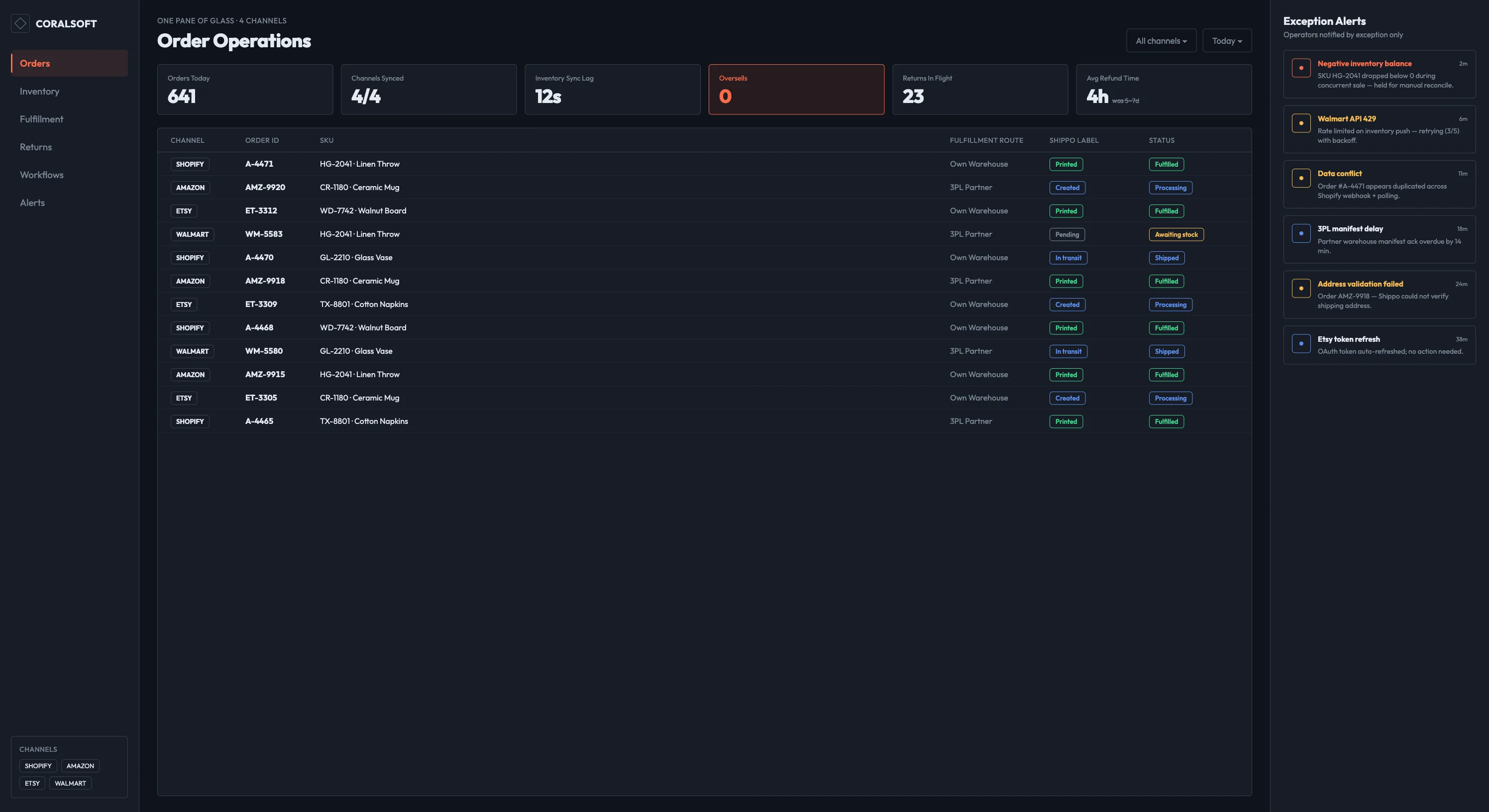
Workflow automation on n8n (self-hosted), no LLM agent — deterministic process orchestration that replaced four disconnected order, inventory, fulfillment, and returns processes for a DTC home-goods brand selling across Shopify and three marketplaces.
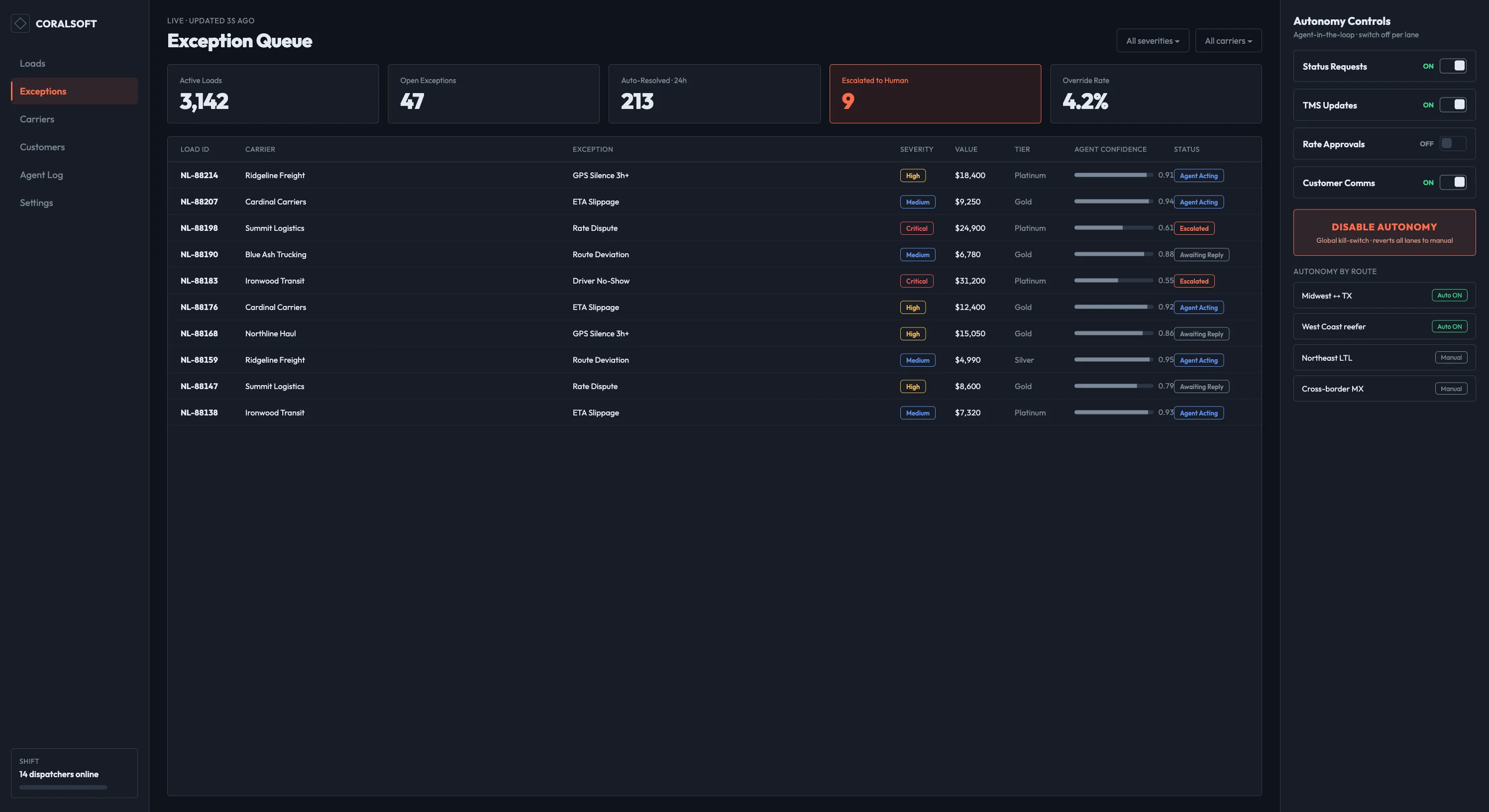
An autonomous AI agent — not a chatbot, but an agent that takes real actions in external systems — built for a mid-sized US freight brokerage to resolve dispatch exceptions across the TMS, ELD, email, SMS, and carrier portals.
We structure engagements to match how much of your process you are ready to hand to AI agents — from a single pilot workflow to organisation-wide agentic rollout.
One process, fully scoped and hardened. Typically $10,000–$30,000 and 4–8 weeks. Best for proving reliability before expanding.
Several processes and departments with full integration and hardening. Typically $40,000–$150,000+, 12–20 weeks, depending on system count and compliance needs.
Ongoing tuning and expansion as new workflows and exception patterns emerge after initial rollout.
The questions teams ask most before handing a process to agents. Anything else, ask us directly.
Tell us which process is costing you the most manual hours. We will map the right agent architecture, integration points, and guardrails, and give you a realistic cost estimate — in one 45-minute call. No obligation.