Task Agents
01 / 05Single-purpose agents that own one function end to end — triaging support tickets, qualifying leads, or extracting data from documents — with a narrow, well-defined tool set.
We design, build, and deploy custom AI agents — from single-task assistants to multi-agent systems — wired into your real tools, data, and workflows.
AI agent development is the practice of designing and building software agents that can perceive input, reason about a goal, take action through tools or APIs, and evaluate the result — with a defined degree of autonomy rather than a fixed decision tree.
Agentic AI development differs from conventional software development in one key respect: instead of coding every branch of logic explicitly, we define the agent's goal, its available tools, and its guardrails, and the agent determines its own path to the outcome. This is what makes agentic AI development a distinct discipline from typical backend engineering — it requires prompt architecture, tool design, and evaluation methodology alongside standard software skills.
Teams asking how to develop an AI agent often start by choosing a framework before deciding what the agent should actually do. Building agents that hold up in production begins with three decisions, made before any code is written: which specific decision or action the agent will fully own, which tools it is allowed to call, and at what confidence level it hands off to a human.
Once those are settled, the technical build becomes straightforward: choose a base model, define how the agent stores information and tracks context, build a controlled interface for the tools it can call, and construct an evaluation set before the agent touches live data. We follow this same sequence on every project, whether we're building a single-task agent or a full multi-agent system.
Coralsoft delivers AI agent development solutions across the agent types businesses ask for most.
Single-purpose agents that own one function end to end — triaging support tickets, qualifying leads, or extracting data from documents — with a narrow, well-defined tool set.
Coordinated agent teams where a planner agent decomposes a task, specialised sub-agents execute steps, and a supervisor agent reviews outputs before they reach a system of record.
Agents grounded in your own data through RAG pipelines, so responses and decisions are based on your documents, policies, and records rather than the model's general training data.
Agents that call external APIs, internal services, or business systems directly — booking, provisioning, updating records — under scoped, auditable permissions.
Agents built for real-time conversation, handling multi-turn dialogue, interruption handling, and context retention across a live interaction.
Custom AI agent development is an architecture discipline as much as a prompting one. The decisions below determine how the agent behaves once it meets real, unpredictable input.
We define how the agent breaks down a goal into steps — single-pass reasoning for simple tasks, iterative planning loops for tasks with dependencies or open-ended scope.
Each agent is given a defined tool set and a memory strategy — short-term context for a single session, long-term memory where the agent needs to recall prior interactions.
Confidence thresholds, action limits, and automated evaluation sets are built in from the first sprint, not added after an incident.
| Layer | Components | Technology Examples |
|---|---|---|
| Reasoning | Core model powering agent decisions | OpenAI, Anthropic, open-source models |
| Agent Layer | Planning, delegation, orchestration | LangGraph, CrewAI, custom orchestration |
| Retrieval | Grounding in proprietary data | Pinecone, pgvector |
| State & Memory | Session and long-term memory | Postgres, Redis |
| Observability | Monitoring, evaluation, cost tracking | Datadog, Langfuse |
No-code agent builders are a reasonable starting point for a narrow, low-stakes task. Custom AI agent development becomes the right call once a workflow involves proprietary data, multiple internal systems, non-standard decision logic, or volume that makes per-seat SaaS pricing uneconomical. Most teams that start with a builder and hit one of these limits end up rebuilding on custom infrastructure within a year.
We follow a five-stage process refined across dozens of agent development engagements.
We define exactly what decision or action the agent will own, the tools it needs, and the guardrails required before writing a line of code.
We design the reasoning approach, tool interfaces, and memory strategy, and document the trade-offs for each choice.
Agent logic and system integrations delivered in two-week sprints with working demos against real data and tasks.
Testing against historical cases, adversarial inputs, and load conditions to confirm the agent behaves predictably before go-live.
Phased rollout, a 30-day hypercare period, and ongoing tuning as the agent encounters new input patterns in production.
Ticket triage, response drafting, and escalation agents integrated with existing helpdesk platforms.
Lead qualification and CRM-updating agents that hand off warm leads at the right moment.
Invoice processing, reconciliation, and compliance-check agents with human sign-off on flagged items.
Intake and scheduling agents grounded in policy documents via retrieval, with mandatory human review.
Order-status, returns, and product-question agents integrated with storefront and fulfilment systems.
Onboarding, access-request, and internal support agents wired into existing ticketing systems.
Coralsoft works as a dedicated AI agent development company — our team is accountable for the agent's real-world performance, not just its demo.
We build genuine agentic AI — agents that plan, use tools, and adapt — rather than a scripted chatbot with an LLM front end.
Our agents read from and write to the systems your team already uses, scoped to exactly the access each task requires.
Every agent ships with monitoring, cost tracking, and defined guardrails — agentic systems that fail safely and visibly, not silently.
Our team has delivered AI agents across support, sales, finance, and operations workflows, carrying pattern-level lessons from one engagement into the next.
Coralsoft has developed and deployed AI agents in production environments where accuracy, auditability, and reliability all had to hold under real load.
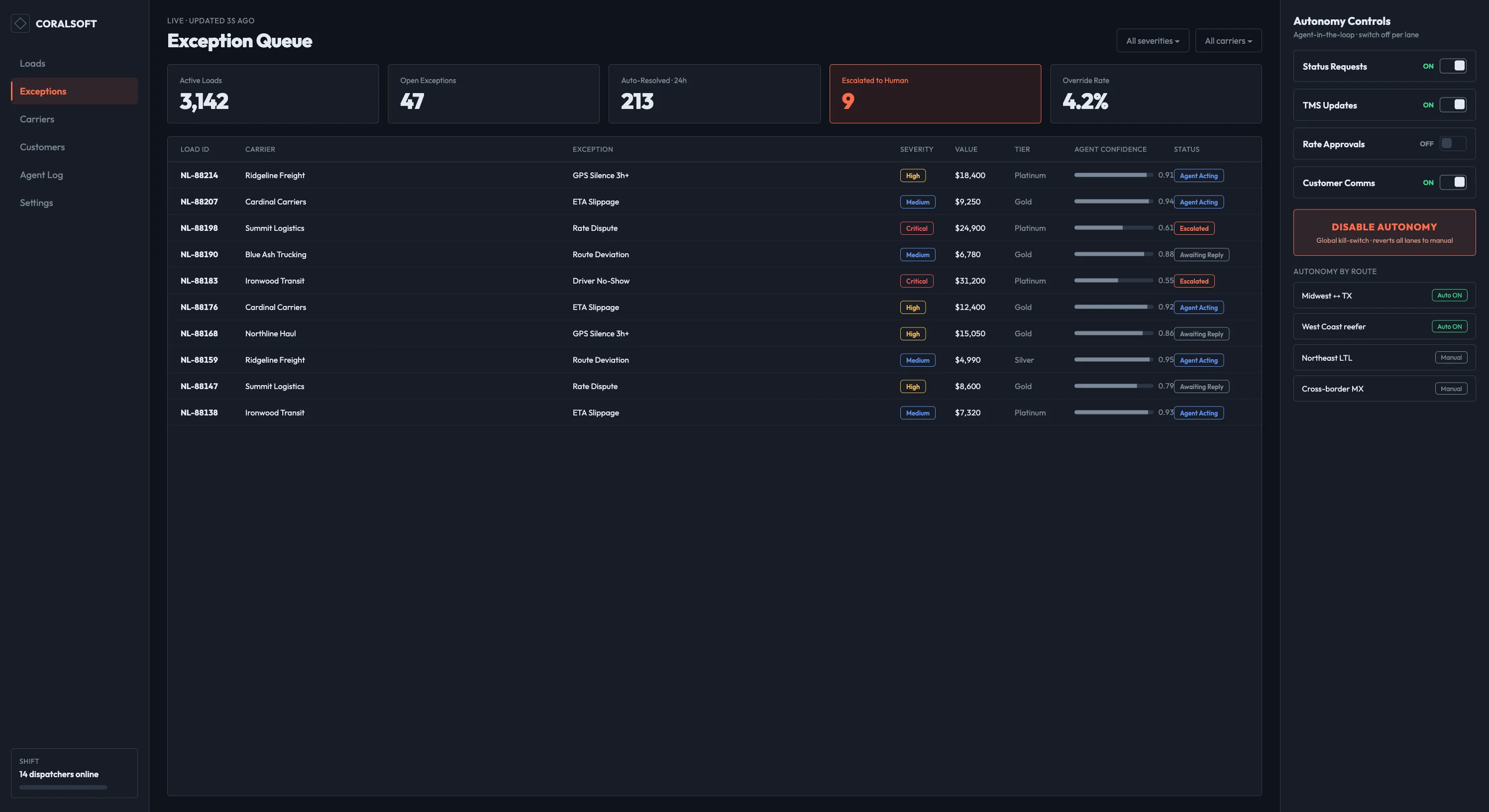
An autonomous AI agent — not a chatbot, but an agent that takes real actions in external systems — built for a mid-sized US freight brokerage to resolve dispatch exceptions across the TMS, ELD, email, SMS, and carrier portals.
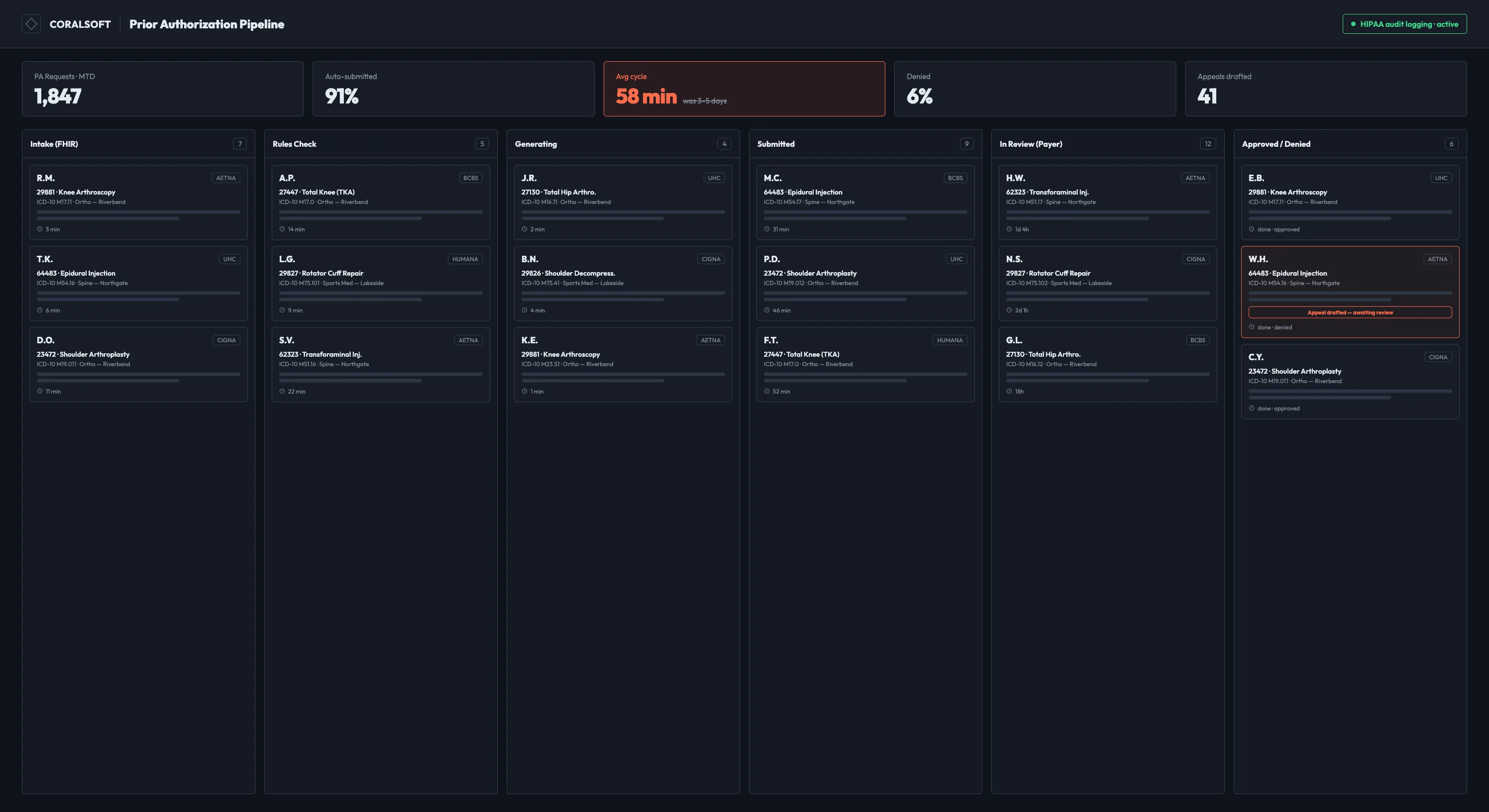
An autonomous AI agent — acting inside payer portals, generating documents, and tracking statuses, not a chatbot — that runs the full HIPAA-compliant prior authorization cycle for a medical billing company serving 22 outpatient clinics.
We structure engagements to match your stage — from a single pilot agent to an ongoing agentic development partnership across multiple teams.
One task, fully scoped and hardened. Typically $10,000–$30,000. Best for validating agentic automation before wider investment.
Several coordinated agents with integrations, memory, and evaluation pipelines. Typically $40,000–$150,000+, depending on scope and system count.
Continuous agent development and tuning across teams as new use cases and input patterns emerge.
The questions teams ask most before commissioning an agent. Anything else, ask us directly.
Tell us what task you want an agent to own. We will map the architecture, tools, and guardrails, and give you a realistic cost estimate — in one 45-minute call. No obligation.