ArgoFetch // Databode · Bodey AI assistant
Streaming AI property intelligence grounded in live Supabase queries
ArgoFetch is a production real-estate intelligence platform built for the Sunshine Coast property market under the Databode brand. The platform serves real-estate agents and investors who need fast, reliable answers about local sales, listing volumes, price trends, and time-on-market data. The product's core is Bodey — an AI assistant that answers natural-language questions about property data using a live Supabase database, not pre-computed summaries.
Bodey is sold as a SaaS product with tiered subscription plans, usage quotas, and an operator-facing admin panel. The system had to resolve natural-language timeframes precisely, enforce strict data attribution, and handle complex multi-tool queries in a single streaming response — all on top of complete SaaS infrastructure: tiered billing, per-user monthly quotas, a configurable operator admin, an interactive property map, and a module system that lets the operator change behaviour without code changes.
The product surface
Coralsoft built ArgoFetch as two linked Next.js 16 applications — the customer-facing platform and the ArgoFetch operator dashboard — sharing a single Supabase instance. The Bodey chat endpoint runs on Edge runtime for zero-buffering streaming; all other API routes run on Node.js. Every Bodey request travels through a seven-stage pipeline — auth & quota validation, chat session resolution, dynamic system-prompt assembly from Supabase, tool registry, real-time tool execution, post-stream cleanup, and usage accounting.
Bodey AI assistant
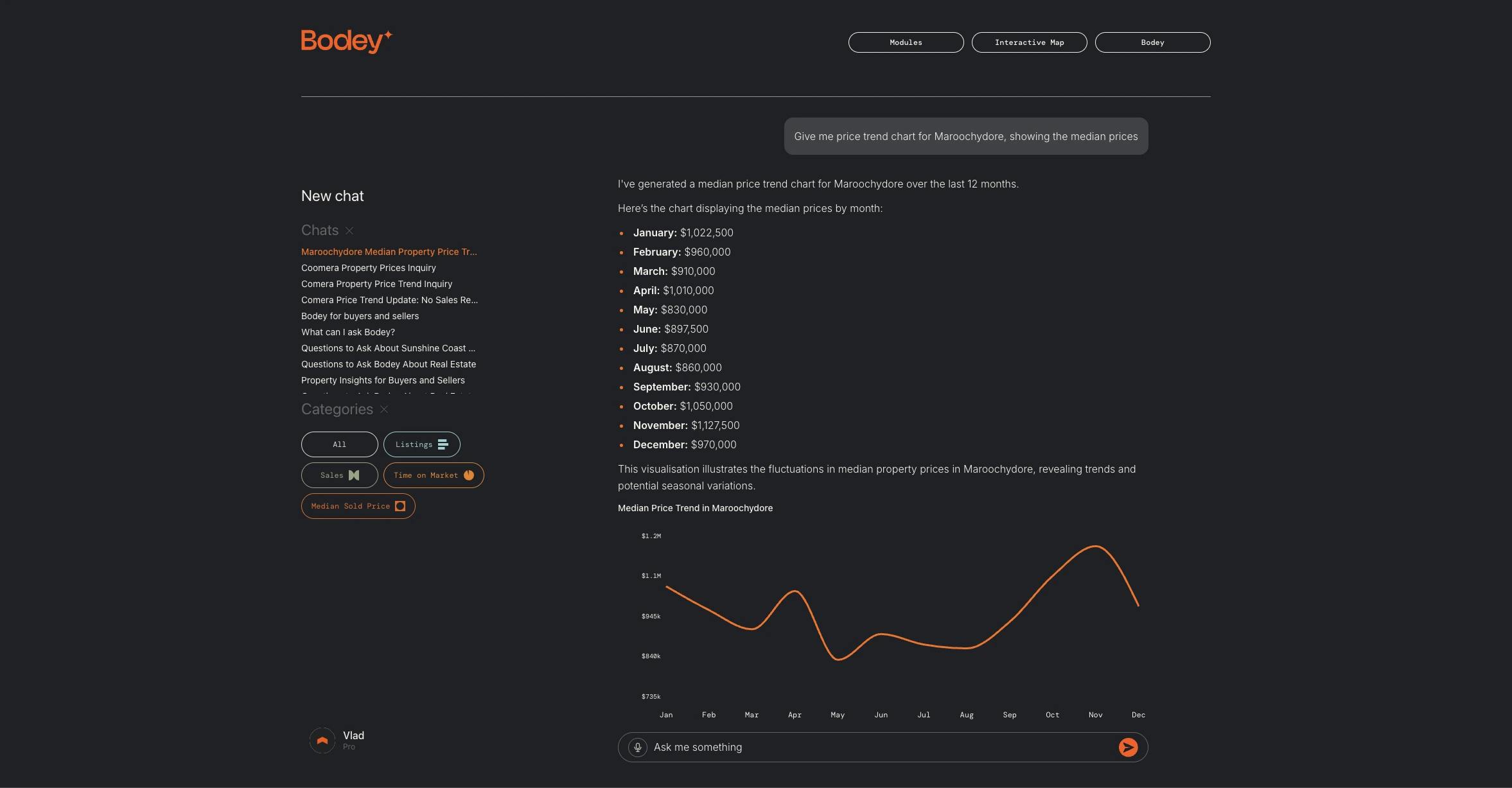
Streaming chat over OpenAI GPT-4o via the Vercel AI SDK, with five Zod-typed tools running live Supabase queries mid-response — enabling chained reasoning and multi-step analysis without leaving the stream.
Five-tool data registry
analyzeSales, analyzeListings, analyzeMatchedListings, buildChartSpec, and getDataSourceInfo — each a typed contract over the live property dataset, with a timeframe resolver mapping phrases like "last financial year" or "Q3 2023" into structured ranges.
Inline chart generation
buildChartSpec returns Recharts-compatible visualisation specs that render inline after the response completes — so chart metadata is extracted from the stream and hydrated client-side without a second roundtrip.
Interactive property map
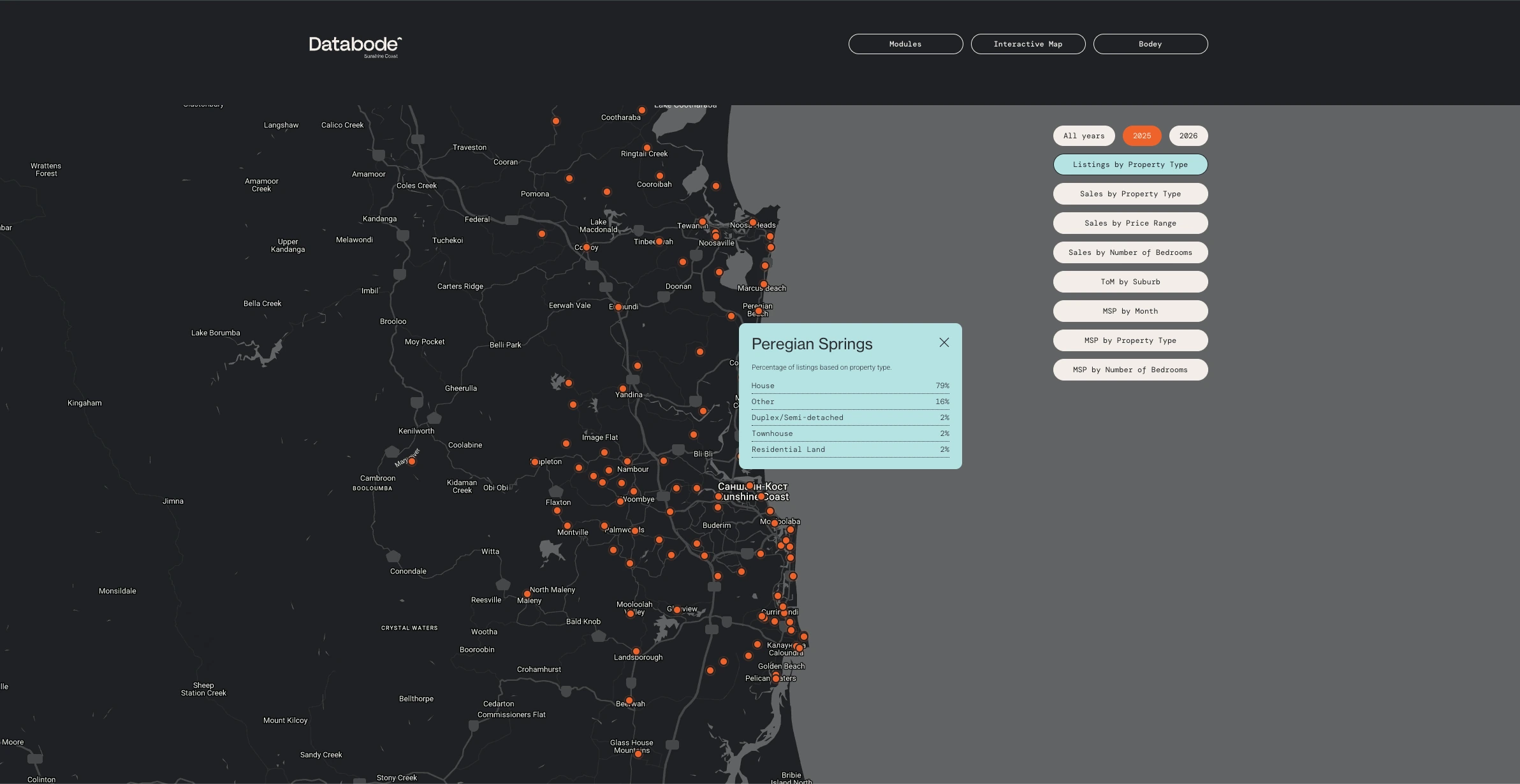
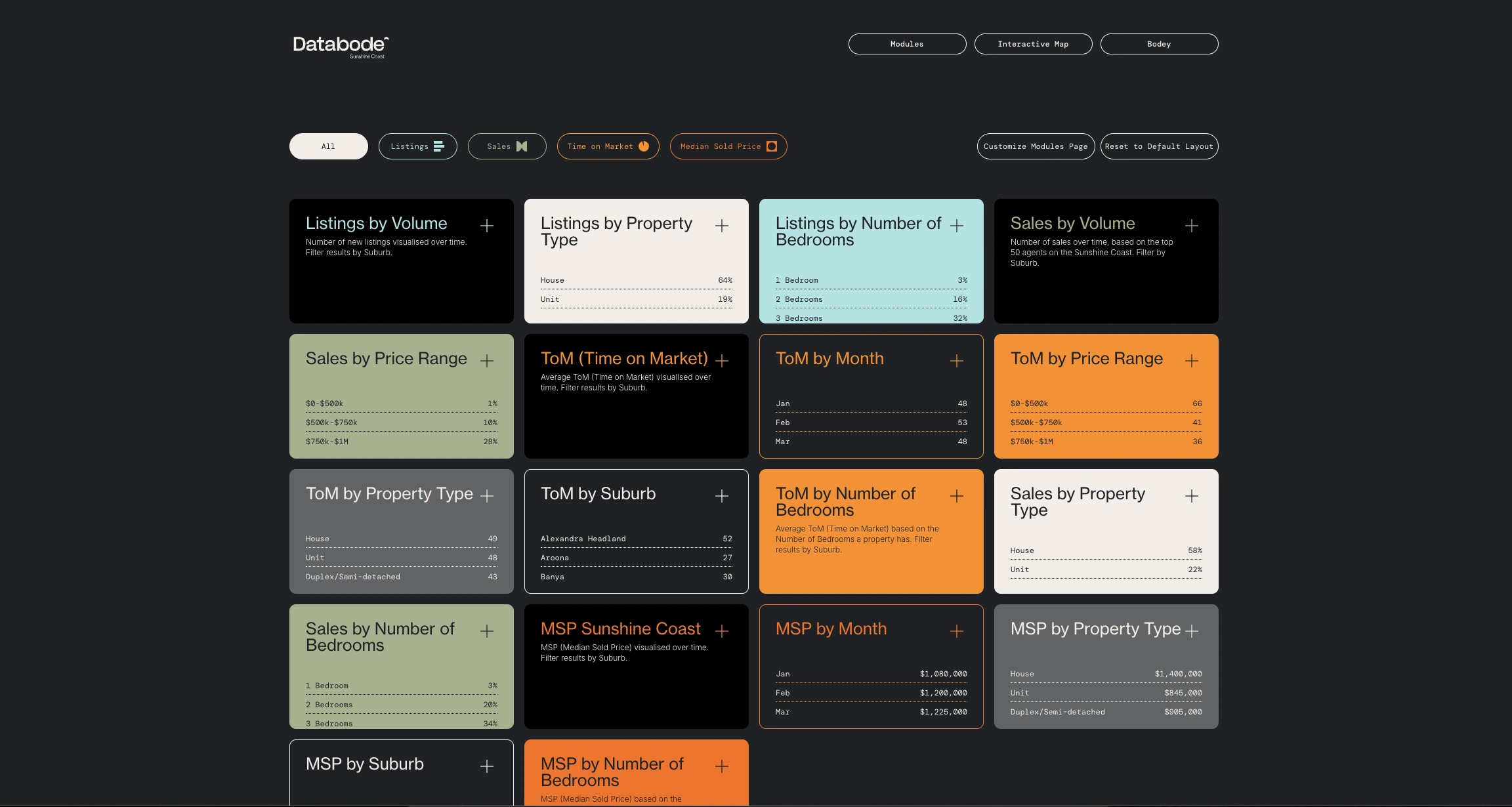
Google Maps API integration with property pins, suburb overlays, and a configurable analytics module system — operators can drag, drop and reconfigure dashboard layouts without redeployment.
Stripe billing + quotas
Tiered subscription plans with per-user monthly prompt quotas enforced at the auth stage of every Bodey request — immediate rejection if exhausted, no wasted tokens.
Operator admin dashboard
A standalone Next.js 16 app sharing the same Supabase instance — AI instructions, pricing tiers, data imports, module layouts and attribution rules are all editable from the admin UI without code changes.
Decisions, not just dependencies.
Two Next.js 16 applications share a single Supabase Postgres instance — the customer platform and the operator dashboard — communicating through Supabase Auth with SSR cookies and Bearer-token API access. The Bodey chat endpoint runs on Edge runtime to keep streaming latency near zero; every other Route Handler runs on Node.js, where the seven-stage pipeline (auth, session, prompt assembly, tool registry, tool execution, post-stream cleanup, accounting) lives.
The AI behaviour itself is database-driven: system prompts, attribution rules, formatting logic, and module layouts are assembled from Supabase at request time, so operators can change Bodey's behaviour without a deploy. Tool calls execute live SQL against Postgres during the stream — no pre-aggregated tables, no caching layer between question and answer beyond an in-process TTL cache for hot read paths.
What was hard, and how we shipped it.
- 01
Seven-stage streaming AI pipeline
Auth & quota validation, chat session resolution, dynamic system-prompt assembly from Supabase, tool registry + model invocation, real-time tool execution against live SQL, and post-stream cleanup (chart metadata extraction, title generation, usage accounting) — all running through one streaming response on Edge runtime.
- 02
Live tool-call data retrieval, not pre-aggregation
Five Zod-typed tools execute live Supabase queries mid-stream — analyzeSales, analyzeListings, analyzeMatchedListings, buildChartSpec, getDataSourceInfo — enabling chained reasoning across the property dataset without ever falling back to a precomputed summary.
- 03
Operator-driven behaviour, no redeploys
Every operational layer — AI instructions, pricing tiers, data imports, module layouts, attribution rules — is editable through the operator admin dashboard. New behaviour ships without a deploy and without a developer in the loop.
- 04
Dual-app architecture on one Supabase
Customer platform and operator dashboard ship as two independent Next.js 16 apps but share a single Postgres database with Row-Level Security per app surface — no duplicated schema, no cross-service drift, no auth bypass.
- 05
Inline chart generation from the AI response
buildChartSpec returns Recharts-compatible visualisation specs as part of the streaming tool-call output. Charts render inline once the stream completes — no second round-trip, no separate analytics endpoint.
Looking at a project that sits at this kind of seam?
Bring us the architecture, the constraints, and the ship date. We will bring the rest.
ClubPulse
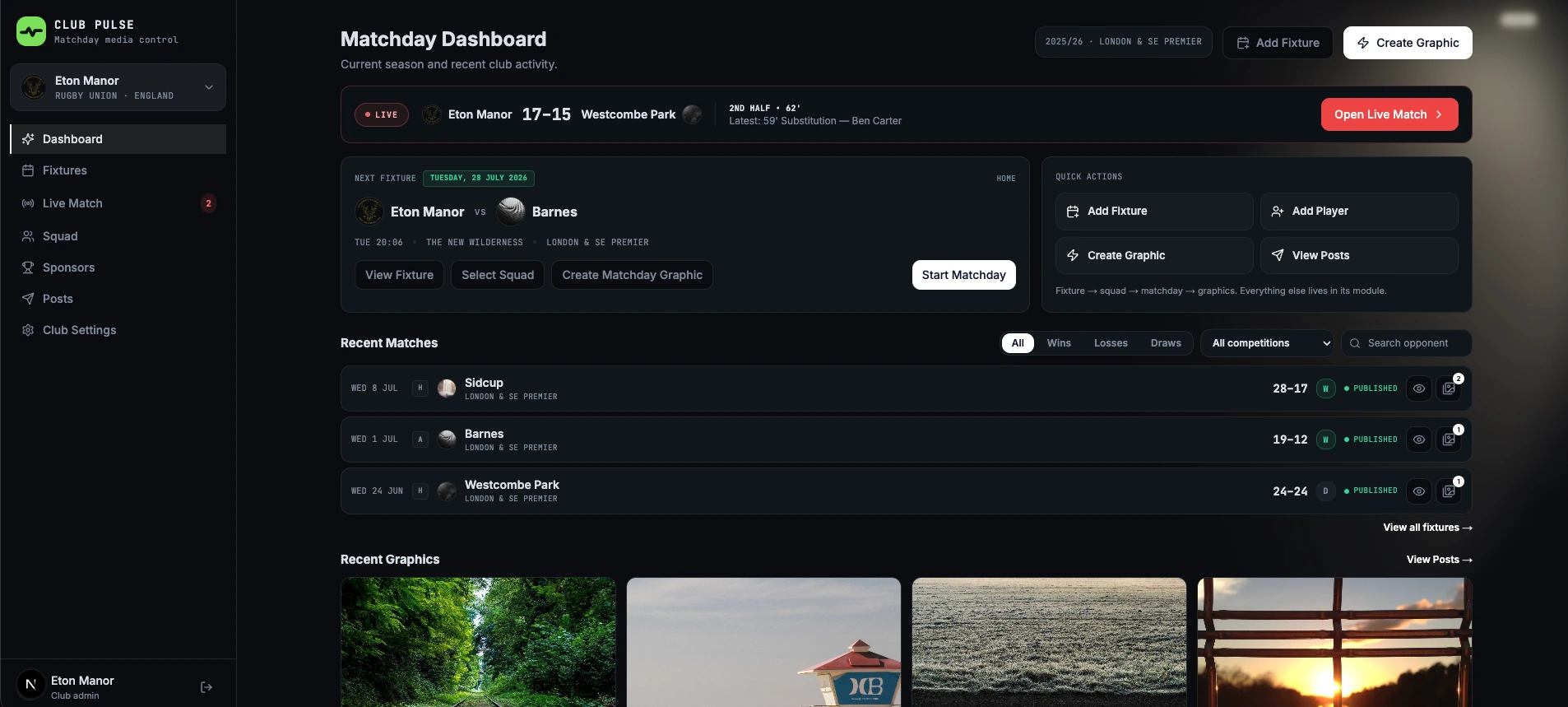
Matchday media control for amateur rugby clubsClubPulse is a matchday media control platform for amateur rugby union clubs. Secretaries manage fixtures and squads, run a live scoring console, generate branded Instagram graphics from 37 templates, and publish to Instagram, Facebook, and X — all in one app. Crest and player-photo cleanup runs in the browser with ESRGAN and BiRefNet, identity-preserving and never generative.
HAIZEL
Blkbook · professional networking PWAA mobile-first progressive web app that replaces the paper business card with a fully customisable digital identity — built from zero to production by Coralsoft.