AI Agents
01Use language models, business rules, data, and connected tools to complete defined tasks.
Coralsoft designs AI agents that read business context, take approved actions, and send unclear cases to people. From one workflow to a multi-agent system, we build around your data and existing tools.
AI agent development is the process of building software that can assess a task, retrieve relevant information, use approved tools, and complete defined actions. An AI agent can work across systems instead of only answering questions in a chat window. Most businesses consider three related options when planning AI automation.
Use language models, business rules, data, and connected tools to complete defined tasks.
Describes systems that can plan and execute a sequence of steps toward a goal.
Combine model selection, workflow design, data access, security controls, and integration work.
Every AI agent we build serves a defined business purpose. We focus on the data, actions, and review points that make the workflow useful in daily operations.
Autonomous agents around your business rules, data, and tools. They assess inputs, select approved actions, and complete them.
Coordinated agents that divide complex work into focused roles, such as research, validation, execution, and review.
Internal assistants helping employees find information, prepare drafts, summarise records, and complete routine tasks.
Customer-facing agents that answer questions, retrieve approved information, guide users through requests, and complete simple actions.
Agents that execute multi-step processes across connected systems, check conditions, trigger actions, manage hand-offs, and log outcomes.
The best use cases begin with work that is frequent, rules-aware, and difficult to scale by adding more manual steps. AI agents can support teams in many sectors when the workflow has clear data sources and a defined handoff to people.
We use a staged process for AI agent development services, so technical choices stay linked to real business needs. Every stage creates a decision point before the next layer of work begins.
We review the workflow, users, systems, decision points, and failure risks. Together, we define a narrow first use case, success measures, and approval rules.
We map tools, data boundaries, memory, handoffs, and escalation paths. The design identifies where a person must review or approve an action.
We compare suitable models, retrieval methods, and agent frameworks. A small prototype tests accuracy, latency, cost, and usability before full development.
We build agent logic, connectors, interfaces, and workflow controls. The agent connects with CRM, ERP, ticketing, or collaboration tools your team already uses.
We test realistic scenarios, edge cases, permissions, and error handling. Evaluation tracks task success, grounded answers, action quality, and human overrides.
We release in stages, start with a defined group of users, and prepare teams for the new workflow. Production setup can include monitoring, access control, and rollback options.
AI agent development requires a practical technology stack. We select components based on the workflow, systems, and security requirements.
AI agents streamline repetitive tasks, manual checks, and follow-up work. That reduces the ongoing cost of regular operations, while keeping people in play for those cases that are actually complicated and require the skillset.
An agent can collect information, prepare context, and trigger the next approved action as soon as an event occurs. Teams spend less time waiting on inboxes, updates, and handoffs.
Agents can receive requests, review available data, and begin approved workflows outside normal business hours. Human teams can review escalations later, with the relevant context already prepared.
AI agents can handle higher volumes of repeatable work without adding the same manual steps each time. Teams can extend workflows with new systems, rules, and use cases.
Agents bring approved data, business rules, and relevant history into one workflow. Your employees get better context before making a decision than having to consult multiple systems or partially correct records.
Agents handle repetitive data checks, updates, routing, and notifications. Instead of copying information across tools, teams spend more time managing exceptions, relationships, and higher-value work.
As an AI development agency, Coralsoft combines software engineering, workflow design, system integration, and practical AI controls. We build custom AI agents around your operating model. We focus on clear use cases, dependable integrations, human review paths, and systems your team can monitor and improve after launch.
Production-grade products. Real users. Measurable outcomes.
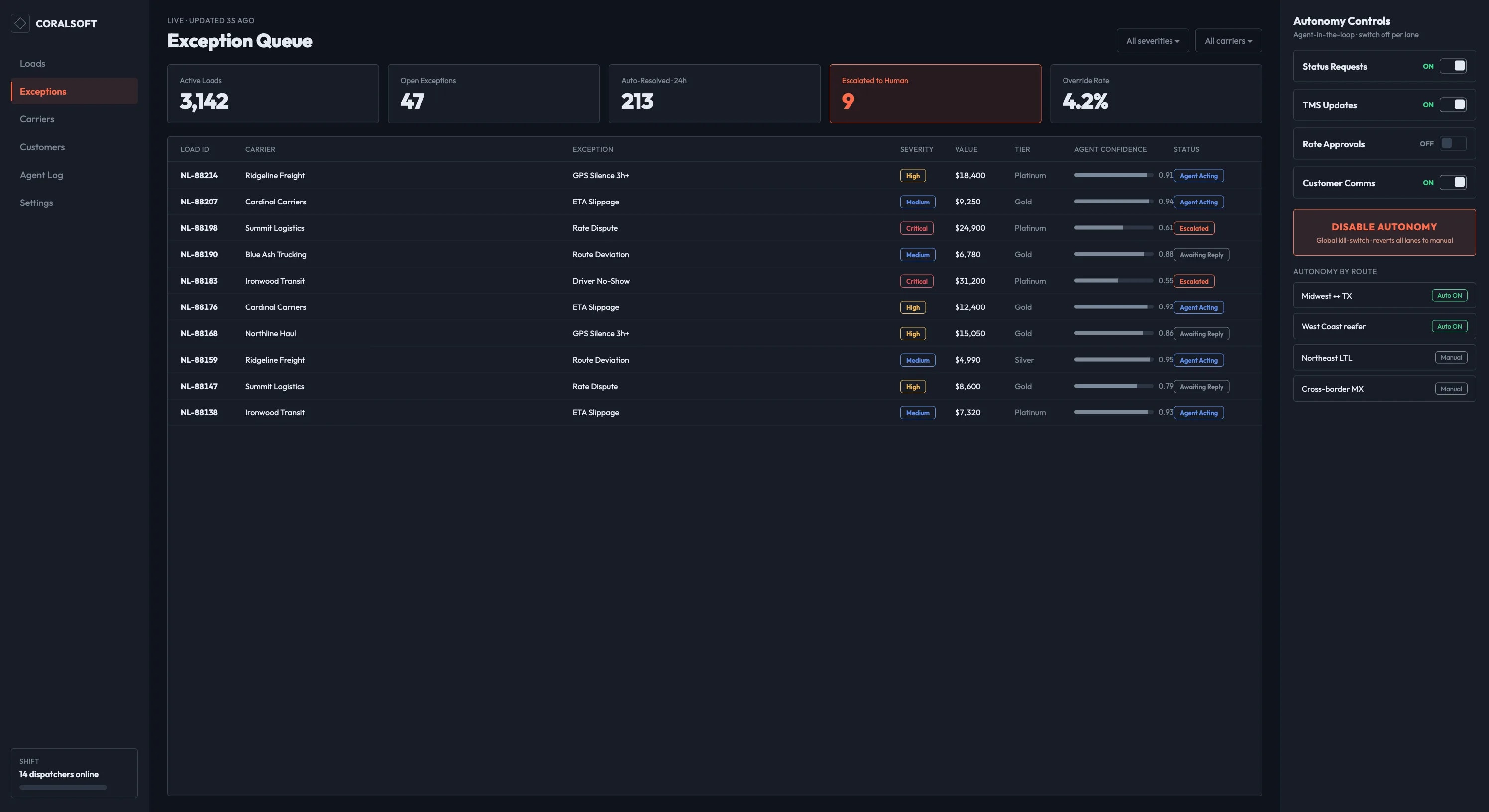
An autonomous AI agent — not a chatbot, but an agent that takes real actions in external systems — built for a mid-sized US freight brokerage to resolve dispatch exceptions across the TMS, ELD, email, SMS, and carrier portals.
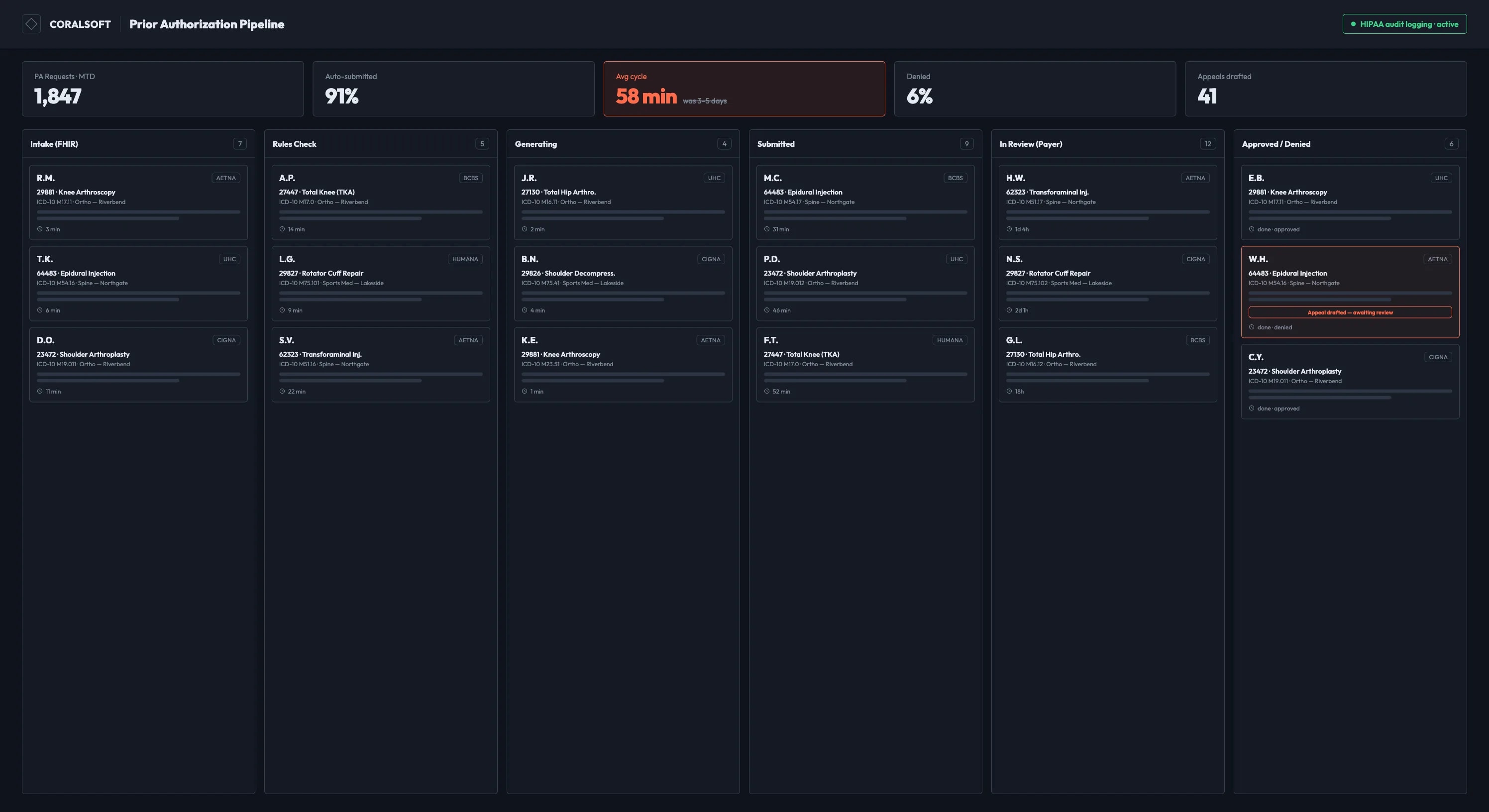
An autonomous AI agent — acting inside payer portals, generating documents, and tracking statuses, not a chatbot — that runs the full HIPAA-compliant prior authorization cycle for a medical billing company serving 22 outpatient clinics.
Answers to the questions we hear most before kick-off.
Tell us about the workflow you want to improve. We will map the right architecture, identify integration requirements, and provide a practical estimate for AI agent development services.